

 One of the most desired effects of testosterone by trans men is a deepening of the voice, a change that’s helpful when moving through the world as a man. However, there’s an uncertainty to voice changes: testosterone doesn’t always drop the pitch low enough, and the changed voice can be persistently hoarse and weak. This can cause both personal and professional difficulties, but for singers, the “unpredictable and irreversible”1 nature of testosterone’s effects on the voice is a terrifying prospect. The loss of singing ability is not inevitable though, and there are strategies for easing the transition of the FTM singing voice. Read on to learn more.
One of my biggest misgivings about starting on testosterone was my singing voice. Beginning as a teenager, I’d performed professionally as a vocalist and guitarist for more than 10 years. Singing was as fundamental to my identity as gender. Would it have to be sacrificed at the expense of transition?
In Body Alchemy: Transsexual Portraits by Loren Cameron, there’s a portrait of author and educator, Jamison Green. He’s posed with a hand drum, and in the accompanying text he explains that he lost his singing voice once he started hormone therapy.2 Here was one of the most visible trans men admitting one of my greatest fears about testosterone! It wasn’t encouraging, so I set out to find some stories that were.
A Guy Named Joe Stevens
The first sign of hope I found was in Joe Stevens of the queer folk duo, Coyote Grace. Listening to Joe’s smooth, high lonesome vocal on “A Guy Named Joe” was clear indication to me that there could indeed be singing after T. Check it out:
Joshua Klipp
By the time I found Joshua Klipp in late 2007, his music had already been featured on television and radio across the United States. His song “Little Girl” gained instant notoriety not only due to Joshua’s powerful performance, but also because it marked the first time in music industry history that a song featured a trans man’s pre-T voice alongside his testosterone-changed voice. Watch his video for “L1FE”:
Simon de Voil
Scottish folk singer Simon de Voil was the subject of the feature documentary Funny Kinda Guy. The film follows Simon through his early transition as he “irreversibly sacrifices his female singing voice to hormone treatment.”3 Although he couldn’t sing confidently for three years, Simon says that since then his new voice has “really grown into itself.”4
Clearly, it’s possible for trans men to continue to sing after starting HRT, whether that’s around a camp fire with friends or on stages around the world. While there’s a serious lack of research in this area, we can look to the science of voice for guidance about how to ease FTM vocal transition.
 How Testosterone Affects the Larynx

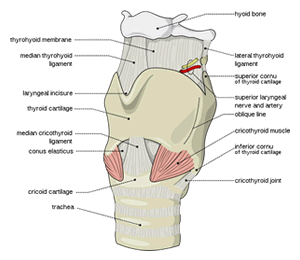
The larynx, or voice box, is a hormone-dependent organ. In teenage boys, increased testosterone production causes the vocal folds (vocal chords) to thicken, lengthen and mature. The cartilage of the larynx grows, further influencing the tone of voice. It also tilts slightly, resulting in a bump on the throat—the Adam’s Apple. This is a process that happens over time as the teen matures.
Trans men conversely, are often started on the highest recommended dose of testosterone, bringing about changes that would normally occur over several years in a much shorter time. Testosterone therapy makes the vocal folds grow thicker but they are restricted in length by the size of the larynx (which is typically smaller in trans men than in cis gender men.) Cartilage growth is said to only happen during puberty5, and early cartilage ossification caused by testosterone further limits the growth of the trans male larynx.
In college I got a Bachelor of Music Vocal Performance as a mezzo-soprano. I lived and breathed being a mezzo-soprano, and felt incredibly safe in my voice. [After] about 3 months on testosterone, I basically couldn’t sing. My range had been reduced to about an octave, and the quality was tinny, crackly, and sort of rusty sounding. There was a grinding that had been created by my cords thickening from the testosterone, and my articulation in my coloratura was gone as well.
I became pretty deeply depressed for awhile, because I actually thought I wouldn’t be able to sing again. Many people had told me not to start testosterone, and at this point I was wondering if maybe they had been right. Maybe I shouldn’t have risked my singing career. In my heart though, I knew that that just wasn’t an option. I had to push through and make the best of it.
Between 3-6 months on testosterone was when I started to get some semblance of a singing voice back. I was able to sing some songs, but there was a persistent airiness to the voice that hadn’t been there before. After 6 months on testosterone my singing voice got progressively better and more stable, but very slowly.
Something particular that doesn’t necessarily have to do with the voice, but with identity, is my shift from mezzo-soprano repertoire to tenor repertoire. I am now a tenor who knows nothing about being a tenor, and who previously didn’t give a rat’s ass about tenors. I have a weird and in-depth knowledge of mezzo-soprano roles and singers, which I often have to explain because it is truly nothing a tenor would normally care about. — Holden Madagame, The Transgender Opera Singer: from Mezzo to Tenor
In his groundbreaking study however, Alexandros Constansis revealed that his 39-year old larynx had indeed grown wider within the first year of HRT.6 Working with a group of FTM singers, Constansis noted that the most common characteristic among study participants was what he called “entrapped vocality.”7 The symptoms—persistent hoarseness and the inability to access and control certain areas of vocal range—were attributed to an inadequately enlarged larynx, due to age and the early onset of laryngeal cartilage ossification. (In some people, this ossification actually improves their singing voice, as the “hardened” larynx is better able to support the vocal folds.)
A professional singer himself, Constansis approached his own HRT conservatively, opting for a low starting dose that was gradually increased over a one year period. He reasoned that “abrupt changes are rarely beneficial to the vocal instrument”8 and suggested that the vocal difficulties experienced by teenage boys could only be aggravated in trans men due to the quickened hormonal changes.
It took about 3 years for my voice to finally settle where it is now. During those years there were several times when I thought ‘Okay, this is my new voice’, and then it would continue to change in subtle ways. I sang professionally for years pre-T and I still sing professionally now. I don’t have quite the range & sustainability that I once had, but anything I lost, I gained in terms of finally being able to own and identify with my voice now. I have no regrets! — Radford Bishop
Recommendations for Trans Male Singers
Throughout his paper, Constansis advocates that trans male singers who are starting testosterone proceed slowly, beginning with a low dose that’s gradually increased over time. While this is likely to slow virilization, it also produces more gentle changes to the larynx, and may be a more significant factor than age with regards to growth of the laryngeal structure.9
In addition to independently pursuing vocal exercises and maintaining good vocal health, trans male singers may also benefit from speech and voice therapy. A Speech-Language Pathologist (SLP) or vocal coach can develop a custom vocal training program that’s centered around their clients’ goals. They can also identify limitations of the changing voice, helping clients recognize the symptoms of vocal fatigue. While it’s important to continue singing through the first year on T—cracks and all—it’s even more important to avoid doing damage to the developing voice.
Lisa Butcher is a Speech Language Pathologist and Vocologist with the University of Minnesota Health Comprehensive Gender Care team. Watch this short documentary to learn more about how she helps trans people to find their voice:
For trans men who have already had several years of testosterone therapy, vocal coaching can still be beneficial. Learning proper techniques for breathing, and opening the diaphragm and larynx, can substantially improve singing abilities.
If you choose this route, look for a SLP who has experience working with transgender people. Not only should they possess in-depth knowledge of speech/voice science and speech masculization treatments and therapies, but the ideal SLP also understands transgender basics (terminology, trans sensitive-protocols, etc.)10
I had been singing all my life, singing is a big part of my family, and songwriting became an integral part of my mental health. When I realized that transition was my path, my voice was the only concern. I set out to find some information about it, and found none. My doctor had nothing conclusive, and most of the transguys I found said that they no longer sang… Not encouraging. But my gut told me that if I could carry a tune before, I could carry one after, and hopefully the tonal quality would be easy on the ears, and I had to move forward. When the voice dropped, the fun began. What I learned is that you just have to keep singing. I had 23 years of muscle memory built up, and that’s a lot for any brain to re-learn. It takes time, but it’s mostly about finding where your new notes are, which can be fun, funny, frustrating, embarrassing – but you only have to do it once, and in the grand scheme of things, it’s a relatively short period of time. Keep singing. If you stop singing, then you won’t sing. Simple as that. The world needs our trans voices, and so do our brothers and sisters, and everyone in between. Sing out! — Joe Stevens
T-Voices
I made a personal decision that I would not let the fear of losing my singing voice obscure my path to transition. Instead, I chose to get excited about how the confidence gained from pursuing my true male identity would positively impact my vocal performance skills. I started with a low dose of testosterone: 50mg every two weeks, increased by 50mg every three months. I knew that testosterone would deepen my range, and I was also prepared for some temporary loss of control. I would need to retrain the muscle memory in my larynx, since shaping the vocal folds and flexing the laryngeal muscles in a familiar way would not necessarily produce the same tone as I was used to. I was advised that practice and patience would help my voice adjust.
Now after 20 months of HRT, the tonal quality of my voice sounds “whiskier” and sometimes I think this has sacrificed clarity but it’s also more rock ‘n’ roll sounding. I didn’t expect the loss of projection that I’ve experienced, but it’s returning with practice. Overall, the most difficult aspect of changing my singing voice has been gaining confidence with it again. It’s a mental adjustment that encompasses more than just my voice—it’s about confidently expressing my new (and not yet fully familiar) identity.
Learning to sing again post transition isn’t easy, but it can be done. Strengthen and stretch your vocal cords at a comfortable pace. Most importantly, however, be patient and kind with yourself and your voice.
— Joshua KlippPhoto credit: Amos Mac, 2009
The “unpredictable and irreversible” effects of testosterone on voice can inject significant doubt into the decision of whether or not to pursue HRT. If testosterone is in your cards, remember that the “no guarantees” clause applies both ways: it’s not inevitable that you will lose your singing voice! Gradual administration of T, speech-language therapy, vocal exercises, maintaining good vocal health, and regular practice will all help ease the transition. And who knows? This woman claims that testosterone is the reason behind her incredible 8-octave range. Maybe you’ll be just as lucky!
More Trans Male Singers
- Julian Morris, member of the Portland OR band, Little Star.
- Eli Conley is a singer-songwriter and voice teacher. Don’t miss his article Transgender Men, Testosterone, and Singing – Some Advice for more guidance and inspiration.
- Lucas Silveira – Front man for the Canadian rock band, The Cliks.
- StormMiguel Florez is a Mexican American singer/songwriter.
- Alex Davis, Los Angeles native singer/songwriter.
- Cris August – Up-and-coming vocalist who blends a pop/contemporary and soft rock sound.
- Geo Wyeth – New York City based musician, performer and interdisciplinary artist.
- Katastrophe is a San Francisco based rapper and producer.
- Alexander James Adams is an American singer, musician and songwriter in the Celtic and World music genres.
- Michael Woodward sings lead for Too Much Information.
- Paige Elliot Phoenix, an Aussie singer who in August 2011 won over the judges on Australia’s X Factor reality show.
Choirs with Trans Men
- Butterfly Music Transgender Chorus – Boston Globe: Members of transgender chorus find their voices (Aug 23, 2015)
- Transcendence Gospel Choir of San Francisco was the first trans choir in the world and features trans men.
- Confluence Chorale – Willamette Valley (OR) LGBT chorus. Trans men welcome.
- Portland Gay Men’s Chorus – Trans men welcome.
- One Voice Mixed Chorus used to have a trans choir. Presumably, there are still trans men in the main choir.
Additional Resources
- How this trans singer lost his voice — and found it again – CBC.ca
- Singing on Testosterone: A Handout for Vocal Transition by Peter Fullerton – Written by a transmasculine voice teacher with 10+ years of experience working with transitioning singers, including one-on-one sessions with 50+ students who are prescribed testosterone.
- Sensible Tips for T Guys: Testosterone & Singing
- CN Lester’s Research: Singing and T and Singing and vocal production for trans guys (with videos)
CN is a classical singer and teacher (with many pupils who are trans men on T), trans masculine, who stays off T for their career. - How the Body Works: Speech and Voice – video
- Anatomical Tutorial During Trans-Nasal Endoscopy – video
- Changing Speech, Shelagh Davies and Joshua Goldberg, Vancouver Trans Health Program, 2006 (420K PDF)
- Transgender Speech Feminization/Masculinization: Suggested Guidelines for BC Clinicians, Shelagh Davies and Joshua Goldberg, Vancouver Trans Health Program, 2006 (844K PDF)
- Voice And Communication Therapy for the Transgender/transsexual Client: A Comprehensive Clinical Guide, Richard K. Adler, Sandy Hirsch, Michelle Mordaunt, editors, 2012 (Second Edition)
- The Changing Female-To-Male (FTM) Voice, Alexandros N. Constansis, Radical Musicology, Vol. 3, 2008
- Voice problems in female-to-male transsexuals, J. Van Borsel, G. De Cuypere, R. Rubens, B. Destaerke, International Journal of Language & Communication Disorders 2000, Vol. 35, No. 3
- Effects of Testosterone Replacement on a Male Professional Singer, Austin King, Jon Ashby and Charles Nelson, Journal of Voice – December 2001 (Vol. 15, Issue 4)
- Middle C – From the Canadian Broadcasting Corporation, this first person audio documentary chronicles Tristan Whiston’s year-long FTM gender transition – through the change in his singing voice. Whiston first performed as solo soprano at the age of six and years of hard work led to an accomplished singing career.
- How To Protect Your Singing Voice
- On Voice and “Passing”, Tobaron Waxman, 2005. Includes information on speech, posture and vocal exercises.
- Voice in Female-To-Male transsexual persons after long-term androgen therapy.
Cosyns M, Borsel JV, Wierckx K, Dedecker D, Van de Peer F, Daelman T, Laenen S, T’sjoen G. Laryngoscope. 2013 Oct 24. doi: 10.1002/lary.24480. [Epub ahead of print] - Why I Sing by lore m. dickey. From Soprano to Bass: A Transgender Man’s Story of Self-awareness, Family and Changing Lives Through Music
Speech-Language Pathologists with Transgender Experience
- Shelagh Davies – Speech-Language Pathologist, Clinical Associate Professor in the School of Audiology and Speech Sciences, University of British Columbia, Vancouver, BC, Canada.
- Sandy Hirsch – Speech-Language Pathologist, co-author and editor of Voice and Communication Therapy for the Transgender/Transsexual Client: A Comprehensive Clinical Guide. Sandy is based in Seattle, WA, USA but provides distance training using Skype video conferencing.
- Anita L. Kozan – Dr. Kozan’s doctoral work focused voice care for singers and actors. She is a specialist in the development of the voice for persons who are transgendered, and her chapter on the singing voice in Voice and Communication Therapy for the Transgender/Transsexual Client: A Comprehensive Clinical Guide has been recognized as the first of its kind. Her private practice is in Minneapolis, MN, USA.
Footnotes
- Medical Therapy and Maintenance for Transgender Men: A Guide for Health Care Providers
R. Nick Gorton MD, Jamie Buth MD, Dean Spade Esq., p. 59 - Body Alchemy: Transsexual Portraits, Loren Cameron, p. 38
- Funny Kinda Guy
- Simon de Voil
- Changing Speech, Shelagh Davies and Joshua Goldberg, p.6
- The Changing Female-To-Male (FTM) Voice, Alexandros N. Constansis, para 17
- The Changing Female-To-Male (FTM) Voice, Alexandros N. Constansis, para 29
- The Changing Female-To-Male (FTM) Voice, Alexandros N. Constansis, para 9
- The Changing Female-To-Male (FTM) Voice, Alexandros N. Constansis, para 29
- Changing Speech, Shelagh Davies and Joshua Goldberg, p.20
Acknowledgments
Thanks to Radford Bishop, Joe Stevens, Joshua Klipp and Lucas Silveira for contributing to this article. Special personal thanks go out to Joe and Lucas for providing me with very helpful advice and inspiring me to keep singing.
Last updated: 04/10/26
This was something I was worried about with transitioning. It’s good to know that with a little work and some foresight, I’ll be able to keep singing! Thanks for providing these resources.
I too was worried about this with transition, and this article really is a great one for guys just starting or considering whether they should start testosterone therapy. I personally found that after about 5 years of T my voice has slid down the range from vienna boys choir type sounds to a hearty and comfortably baritone which came in handy over Christmas.
I will admit, my 3 octave range is no longer with me, but neither have I practiced and done the recommended stretching. The voice is like any other musical instrument, one needs to continue practicing. I have recently begun considering stretching the old vocal cords and seeing if I can at least get back into choir and this winter vacation I’ve been thinking I might do just that.
Thank you also for putting the links to various trans male artists in here, I really enjoyed learning of some new singers to keep an eye on!
thanks for an informative and clearly layed out piece. I passed it on!
Joshua, awesome article–so sorry I didn’t have a chance to get back to you for my input. I totally concur–just KEEP SINGING! You’ll find your way. You might have to work on it pretty hard for a few years, but it is worth the effort.
I was a classically trained soprano, studied voice throughout high school and college, and had been performing in community theater and coffeehouses for decades before my transition. At 36, I was very concerned about how T would impact my life and my mental health if I could no longer sing, which seemed to be the general consensus among the few guys I knew at the time.
I found that my karaoke machine was really helpful–I used it to sort of monitor the changes. What used to be a “Broadway mezzo” soprano voice is now a whiskey-blues tenor something along the lines of, say, Bob Seger meets John Denver. Works really well for classic rock and blues that we do in the band. And sure fits my psyche better–there just wasn’t a lot of work out there for butch sopranos.
If you can afford it, you might consider voice lessons with a voice coach. Look for someone with experience working with adolescent boys. (I’d recommend starting with your local university’s music department.) It’s important that you don’t overdo it while it’s changing, but you don’t have to completely abandon it, either.
Another great way to keep singing regularly is to join a chorus. There are trans-friendly choruses all over the place–to find one near you, check out the organization GALA Choruses (www.galachoruses.org), which links together LGBT and allied choruses across the planet.
In Tucson, Desert Voices (www.desertvoices.org) is an LGBTQS chorus open to anyone who wants to sing. We have at least two transmen, several female tenors, and our accompanist and artist in residence (so to speak) for several years was the amazing trans folk artist namoli brennet.
Don’t shrug singing off as a “necessary sacrifice”, because it isn’t. Singing is what keeps me going, and I was not willing to accept defeat. In fact, focusing on my voice changes kind of helped distract and entertain me throughout the otherwise intense and sometimes painful journey. Now ten years later, I have no question it was a change for the better–voice included.
Wow, this is amazing! I’ve been dealing with this issue for a while, wondering about how testosterone shots might affect my voice, especially since I’m a serious musician, and this site just popped up! My own personal miracle! ;D
Excellent article, fascinating to read as I have enjoyed singing throughout the years. Prior to ‘T’ I sang in a women’s choir moving between a low soprano and a higher (female) bass. Once I commenced ‘T’ 18 yrs ago the biggest thing for me would be that my singing voice would become very deep as that was the range I liked to try and sing as a child.
I remember being aware of not straining my voice if and whenever possible, this was something I learned from an old Australian singer, Johnny Young, who had a singing show with kids…Young Talent Time. When the boys on the show got to the point where their voices were breaking they didn’t get to sing very much and particularly songs that would overly strain their vocal chords so I had kept this in mind but did continue to sing.
In the first couple of years I joined a G&L choir as a bass but never having had formal training I struggled with the decision as to which bass, 1st or 2nd…fortunately the choir master sorted that out and told me to my unbelievable delight I was 2nd bass, man I was stoked to the hilt.
Since having left Sydney 10yrs ago for Newcastle, NSW, Australia I was left devoid of singing but have fortunately found a community group. What I have noticed over the years has been my ability to use my diaphragm much more effectively, and to be able to project my voice during extended phrasing of songs still on the one long breath.
My son-in-law tells me I can’t sing and I know I’ll never be a great singer but I have reached the point where I always wanted to be vocally so that in itself is a success. But most importantly I sing for me because it gives me pleasure whether it be in the car, shower or walking around the supermarket doing my groceries no matter what looks I get.
Again, an excellent article.
Cheers
Thanks for the great info on singing post T.
Wish I’d seen it when i was just starting out.
I have some over-dubbing of the male voice on old female tracks…one of my song samples has it if you check out my website.
hope you’re doing well everyone.
Phoenix
I am a 19-year-old FTM and I have been on testosterone for 14 months. I took a few classes on singing before I began T, but once I was on T there were many months where I did not practice singing. I very recently began taking singing lessons again, and my strong range at this point is about 2.5 octaves, which I think is good considering my situation.
There is more tension in my voice compared to before T, and I believe it is because I am still learning to use my “upgraded” vocal chords. My tone is as good as pre-T, though, and I’m able to match pitch just fine. My breath support has gone down, but this could just be a matter of practice.
I believe that both taking singing classes prior to T and the low dose that I am on has helped my voice to transition smoothly thus far. I have not had any cracking or breaking.
A great article, but as a linguist I need to comment on some issues.
The symptoms of what Constansis labels as “entrapped vocality,” such as persistent hoarseness and the inability to access and control certain areas of vocal range were attributed to a) an inadequately enlarged larynx, b) age, and c) the early onset of laryngeal cartilage ossification. I would like to comment on these one by one.
To this date, no representative ENT (ear-nose-throat) measurements have ever been done on pre-T transmen and the same transmen after 1year or 3 years on T so accounting for any change with the (lack of a) dimensional change is purely a hypothesis. If indeed as Constansis observes his “larynx had indeed grown wider” we still know virtually nothing about the vocal folds and their behaviour, as the (command of) pitch is a function of the length (back-front dimension), thickness (top-bottom dimension) and tension of the vocal folds most importantly, and only secondarily a function of the width.
Now onto age and a somewhat related measure, the onset of laryngeal cartilage ossification. As it is noted in the ENT literature, the onset of ossification (or calcification of the cartilage) is put anywhere between the ages 20 and 80 without any strong gender or ethnicity predictor. In a study of excised larynges they found late teens with partial ossification (some cartilages were, some weren’t) and heptugenerians without any form of ossification. As faster-than-normative ossification in the laryngology literature is connected to hoarseness only in cases of osteaosarcoma and chondrosarcoma of the larynx (i.e. serious tumours), or arithritis, the assumption that ossification is responsible for hoarseness and vocal instability in transmen is not supported by the literature and possibly needs further clinical research.
After this short reflection I would like to suggest three other causes for the above mentioned symptoms besides or in place of the above mentioned.
Hoarseness and vocal instability are very common, documented symptoms of vocal abuse and vocal fatigue. Complaints such as “I cannot project at my (new) comfortable pitch level” or “My voice gets tired by the afternoon” and “People have a hard time understanding me in a noisy room” may may stem from insufficient breathing management (think binding!) and the “usual suspect” of trans male speech, that is, creaking. Creaking happens when, trying to sound low(er), people lower their pitch to the pitch floor and often drop into a grating gravelly voice quality. Sustained creaking not only taxes the vocal folds and makes them “raw” but also creates the impression that the speaker is trying to sound low — and can’t.
The vocal instability (voice breaking, cackling laughs, etc.), as long as it is temporary, is a natural outcome of a re-adjustment process. Your vocal muscles are getting used to the new weight and new thickness of your vocal folds that grew heftier due to T. You will have to find your chest voice, your head voice and you have to re-discover where exactly the two meet — that is your voice breaking point. Around that pitch you’re the most likely to have lesser control over what comes out of your mouth. But as most everyone recommended: practice gently, practice constantly, and go see a speech pathologist.
Another recursive issue is the pitch drop and the change in pitch range during transitioning. In my study I have been following 7 transmen in their first year of transitioning regularly measuring their pitch and pitch range (usually once in every T shot cycle). So far, as the sample is limited, it is not possible to predict how much the pitch floor or the habitual pitch will drop. How much of a range you end up with, on the other hand, is possibly less of a function of physiology than identity. It is noticeable that some transmen are not comfortable exploring the upper end of their pitch ranges (either in speech or singing) for fear of sounding less male or more female. This may create the impression that these transmen lost their upper range and their total pitch range has decreased. In clinical practice, especially in the hands of an unassuming practitioner, this would be cause for treatment. It was also observed that typically the more gender variant the speaker is, the more comfortable they were at higher speaking pitches. These speakers could comfortably speak at a lot lower pitch, but they (consciously or unconsciously) choose not to do so. To give an example imagine the stereotypical gay cisgender male voice or the gay transgender male voice.
Finally, my research has shown that there is one more physiological feature that we perceive speaker gender by about as strongly as we perceive pitch: the length of the vocal tract. This length, the one from your lips to your larynx, is creating the so called amplified harmonics or formants in your speech. Whether these formants lie will tell the listener about your height and your gender.
Right now I am in the process of running an online voice satisfaction questionnaire targeting transmen only. If you have questions you would like to see asked in the questionnaire, or you would like to take the questionnaire, please contact me at vica@rice.edu.
I found that my singing voice got more projected and controlled after starting T, perhaps a confidence thing?? However my control and quality seem much better than before even without lessons (not a professional singer nor planning on becoming one) just a fan of singing for my own enjoyment and small open mic nights.
Thanks so much for this article. I am about to start T soon, and I have been a singer for several years. This was one thing I was quite nervous about. You have eased my mind a bit.
more info about voice change in:
http://itsnotmyfault.files.wordpress.com/2009/01/quantifyingtheimpactofandrogentherapyonthefemalelarynx1.pdf
CBC Radio documentary Wednesday July 7, 9:30am PST
“Middle C”
Ftm singer Tristan Whistan documents his voice change.
CBC Radio One 690 AM, 88.1 FM and Sirius 137.
Very good. If you miss this, it might be available by their podcast….
Phoenix Wisebone
Thanks Phoenix! That documentary is available already via the BBC: Tristan Whiston chronicles his year-long gender transition from woman to man – through the change in his singing voice. Definitely worth checking out!
Great! I was extremely worried about my singing voice change if I started my T but this is showing a hopeful ray of light down on my pathway now! I would love to continue to sing!
thank you for this awesome article.
i’m 23 and pre-transition, but have been “out” for two years and questioning for years more. i just switched my health insurance to blue cross but don’t even have a primary doctor, so there are many hurdles for me to cross yet. i find myself procrastinating in part as a response to my many hesitations. unfortunately though, after binding my particularly large chest every day for the last two years, it’s becoming increasingly more urgent for my physical health to seek medical attention.
singing has been one concern for me and it’s great to find affirming stories and discover great trans musicians with beautiful voices. though i’m no professional, i have been playing instruments, in choirs, singing in my car and to garageband on my computer for years now. music (and singing/pitch/control over tone) is a huge part of my life and identity.
just yesterday i was asked by my new roommate if i was planning on starting hormone replacement therapy. the fact is, it’s definitely something i’ve been considering for a long time. i am taking my time, as i personally would prefer to work through my hesitations in therapy before leaping into the “irreversible” changes and the fear of the unknown.
there is so much to say about where i feel at in my transition, so instead i started with the tip of an iceberg by responding “you know… i’m afraid i won’t be able to sing!”
though that’s obviously only one concern, it matters to me. seeing this article today and reading someone’s decision to embrace the change and feel fully comfortable in a voice that more accurately meshes with their identity, as well as their conviction not to let this fear (or others) stand in the way of their path to transition has given me a bit more confidence and conviction for myself in this department.
maybe the voice i find will be the inner one i’m looking to unleash. though it has not erased my fears, reading something informative that directly corresponds to this little discussed topic really helped. so thanks guys.
p.s. i’m a queer artist making a lot of queer/trans art and if you like that kind of stuff, visit my website and buy a tranny postcard 🙂
I am a 52 y.o. transguy in my first stages. I want top surgery first, then (or during) I will go on low doses of T, taking in the advice given by many of you. I have been singing in choirs and groups since I was 7 years old. My concerns are that the voice won’t be as controlled as it is now.
Thanks for your information.
Wow, I am so stoked to have found this article. Since I hit 48, my voice has dropped an octave as it is, I have gone from 30 some odd years as a contralto, to a bass in less than 6 years. I also lost at least an octave or more in my (once upon a time) 3 octave range, and a tremendous amount of breath control after a serious hernia surgery 2 years ago. Now that I am starting T, I just assumed I would lose whatever was left of my singing voice. I don’t know how to sing bass. I have 40 years of singing alto and tenor in choirs. Learning to sing something other than the 3rd and the 5th will be a dramatic challenge. Professionally as a soloist, dropping down however many octaves wouldn’t seem that difficult, just a little retraining the mind to tell the vocal chords where to go I would think. Still, that’s a lot of unlearning and relearning to do. This does give me hope that it can be done. Thank you! Truly a brilliant and well researched article!
I wouldn’t call myself a singer, but I am and always have been a musician and have enjoyed singing for my whole life. I sang one semester in a women’s chorus and three semesters in a men’s chorus while in college.
Before Testosterone, I often sang with the radio and for fun… but I always sang in my “chest voice,” which was a “contralto” range — only a smidge higher than the typical Tenor I range. I could sing many (if not most) of the men’s songs on the radio in the same octave the guys were singing in.
When I joined the women’s chorus (as a credit for my music major in college) I was disappointed to find that women in choirs are typically expected to sing in their “head voice” so when I did that I sang Soprano II. It was a good but strange and somewhat uncomfortable experience singing with the women, because at that point in my life I didn’t know I wanted to transition, but I was keenly aware of not being a woman… and while I appreciated my ability to contribute my voice to the beautiful music of the chorus, I never would have felt comfortable singing in my head voice in a more solo fashion. It always felt like my voice was supposed to be lower, which is why I always sang in my chest voice, singing tenor parts.
I started Testosterone at 200mg/biweekly for the first six months and then changed to 100mg/week. I don’t recall any drastic “DROPS” in my voice… it just seemed to gradually slip lower over the first several months. At three months on T the change in my voice was partly lower in speech, but more so in timbre — it was rough, husky. By the end of 6 months it had mostly finished dropping, with the following several months having my voice mature in timbre and gaining a couple of notes on the bottom. I have a small adam’s apple now that I didn’t have before T.
I sang in the men’s chorus at my university after eight months on T. That semester I sang Baritone (/Bass I), and sometimes the higher notes of that range were hard for me. Then there was the summer break and the following two long semesters I sang Bass II – which is the lowest common voice part. As far as I know, the directors of the men’s chorus never knew I was trans. I got a kick out of the fact that as a transguy I could hit lower notes than 3/4 of the guys in the chorus… but I’m also not surprised that my voice is a bass now — it started out a little low before T and both my dad and my brother sing bass.
However, my speaking voice wouldn’t lead you to believe that I sing bass. It’s not high, but it’s not particularly low either. I have a hint of what I call “tranny voice,” but I also suspect my voice hasn’t finished maturing at two and half years on T now. I suspect that over the next several years my voice will mature not in deepness but in timbre in the same way that a teenage boy’s voice matures into a man’s voice as he grows older.
After spending time around lots of transmen, I’ve noticed what I just called “tranny voice” – it’s generally not something that would out a transguy to your average Joe, but I’ve noticed that there’s a certain timbre in the speaking voice that’s common among transguys but not common among cismen. I don’t have a good way to describe it, except that maybe it’s a little more “airy” or “pinched” than most men’s voices. It leads me to believe that there is in fact something slightly different going on in the biology of voice changes in transmen.
hey all, you should watch a documentary on this:
riot acts: flaunting gender deviance in music performance
it’s all about trans, the voice, and singing as well as a bunch of other stuff. it’s great and should be available soon on netflix. dist. by outkast.
Thank you for posting all of this information. Your voice sounds great, and I love the song.
Hey there,
I’m a professional singer and singing teacher – staying off T for the sake of my voice (classical music) but I’ve started working with guys negotiating the changes T is making – Just put up the first two videos of the project – hope they might prove helpful.
http://cnlester.wordpress.com/2011/06/22/singing-and-vocal-production-for-trans-guys/
I’m happy I found this article. I hope I can retrain my voice to sing to some of the quality that I used to be able to; its a lot lower than I thought it would be. Music was such a big part of my life pre transition- every day for 15years I was music and theater; it just eats away at me at the thought of not being able to regain singing. *crosses fingers* Here’s to not giving up!
Really informative article about voice and voice changes on T. I am a broadcaster and am in the very early stages of transition ftM and I really don’t know what my voice is going to turn out like. But I am going to let nature take its course. It has been good to read about what you singing guys have experienced and it does set my mind at ease somewhat.
james
I used to be able to sing so Coheed and Cambria, Dance Gavin Dance, or Circa Survive. Now I have to concentrate really hard to try to accomplish a vocal range close to the singers in those bands to no avail. So, I just sing in deeper tones.
Hey, I just wanted to let the Oregon folks know about Confluence Chorale and Portland’s Gay Mens Chorus both of which embrace transmen singers 100% through vocal training, practice, and live performance. Ray Elliot, the founder of Confluence wrote his Master’s thesis on trans voices, and the chorale is non-audition, open to straight, gay, lesbian, queer, bi, and intersex or trans people. They perform 6 times a year in Portland, Salem and Corvallis. Check out their website for more info.
Thanks kris! I’ve added links to Confluence and the Portland chorus to the choir section above.
I made a vlog of my transition…. by singing cover songs!
I’m a professional singer-songwriter and a voice teacher who is out as a transgender man.
I’m very glad you’ve put this resource together, as I often get questions for transmasculine singers about what will happen with their voice.
I put together this page with my advice and reflections for others on the FtM spectrum wanting to negotiate singing and testosterone, and I’d be happy to have you include it here if it feels helpful – http://www.eliconley.com/1/post/2013/02/transgender-men-testosterone-and-singing-some-advice.html
Great article, Eli! Thanks for the heads up (and reference to this piece in it.) I’ve included links to your website and article above, under the heading More Trans Male Singers. Thanks again!
Thanks Josh! I appreciate you including me here. And yes, I’m very glad to point folks your way.
A bit of an update on my research into the effects of T on singing voices:
http://cnlester.wordpress.com/2013/01/15/singing-and-t-some-tentative-thoughts/
FYI – I’m a classical singer and teacher, trans masculine, who stays off T for their career – many of my pupils are trans men on T.
Awesome stuff, CN, thank you!! I’ve included links to two of your posts in the Additional Resources section: the recent “Singing and T” as well as “Singing and vocal production for trans guys.” I placed them here rather than under Trans Male Singers only because that section is intended to provide examples of T-changed voices. I hope this is OK with you. Thanks again!
Also, to you and Eli, are you accepting new students? I was thinking of adding another section to this article for vocal instruction–specifically singing as opposed to speech pathology–and could include links to your websites there as well.
Hi Joshua,
Yes, I am taking new students – so long as they don’t mind being flexible around performance schedules. Thanks! CN
I am 2 months and 2 weeks on T and my voice cracks in between not as low as id like it to be but sometimes i do practice because when i go out to places i dont like to be called specific pronouns. My question is i know T will help it drop later on but will speaking deeper now affect my vocal cords to become weak and not thicker or will it affect my voice from being deep as its going to be later on, should i just be natural or will speaking deeper help my voice to actually becoming deeper later on naturally. Im so paranoid and i have no idea what to do..my mom told me that if i continue i could affect my voice like the vocal cords to becoming weak and not having a strong deep voice but at the same time not sure if she was telling me that to be supportive or not. Sometimes my chest does hurt from speaking deep but im not sure if thats normal or not and i feel out of breath. My familys not all about this so im pretty much on my own
Thanks for your questions, Nathan. Nothing to worry about here. You can speak like Barry White or Alvin the Chipmunk and it will not affect the changes that testosterone will cause in your larynx. Just be patient. I think it took a good 2 years for my voice changes to settle. During that time, I always knew when something was happening in my throat because I’d get a little sore throat and hoarseness. I consulted with an ontolaryngologist and he assured me that all was progressing normally. Next time your Mom suggests that you could be causing problems, ask her to pony up some medical evidence! 😉
Thank you so much for sharing this info. Took me done tone to find an answer to ease my fear. I love harmonizing more than the front man vocalist but having the option. To do either is nice but neither would leave me as a player. Piano player , guitar player. Maybe the slang player but don’t want that.
So thanks again for taking time to share your story and knowledge.
It help greatly with the courage part
You’re welcome! I’m really glad you found this helpful!! (I love harmonizing too!)
Hi Joshua, sorry for this years late response, I am just now seeing your comment! I am accepting new voice students. I work with people in person in the Bay Area, and online via Skype. Interested folks can check out https://www.eliconley.com/voice-lessons.html. Thanks!
What I’m really concerned about is the fact that I may never be able to hit high notes ever again. I’m really proud of the fact that I can hit high notes, and it’s something I spent years getting better at. I’d really like to start HRT but I’m afraid I may lose my ability to hit high notes, and I’m not sure I’d be able to handle that. I don’t know what to do.
It honestly never occurred to me when I started T that I could lose my singing voice. I’ve never been a professional singer, but it’s one of my favorite hobbies and I did voice lessons in high school. At the time I was a really low alto. When I started T I kept progress on how low my voice got and was still singing casually without any additional training, though I really only ever used my chest voice for years. I assumed, likely due to self-consciousness and dysphoria, that “male” voices were much lower than they actually are and sang along with all my favorite songs down the octave. I worried that if I sung too high I would not sound masculine. I started doing voice lessons again a year ago. I’m a baritone now and the biggest challenge for me has been learning to use and strengthening my head voice, but after months of practice it’s starting to feel good.
Overall it’s been fine for me. I sing lead in a poppy punk band and I think my singing voice is well suited to my genre. I can sing all the low notes I hoped I’d one day be able to. I probably lost some high notes but I wasn’t using them much pre-transition and I don’t really need them.